|
Canvas (+ Triggers) Programming: Allen Fogelsanger Canvas and Canvas + Triggers are audience-interactive installations of the programs we use in performance. Canvas is video-only with the projections responding immediately and directly to changes in the camera's field of view. Canvas + Triggers presents a more complex interaction of video and sound that does not necessarily respond immediately or directly to the moving participant's actions. |
|
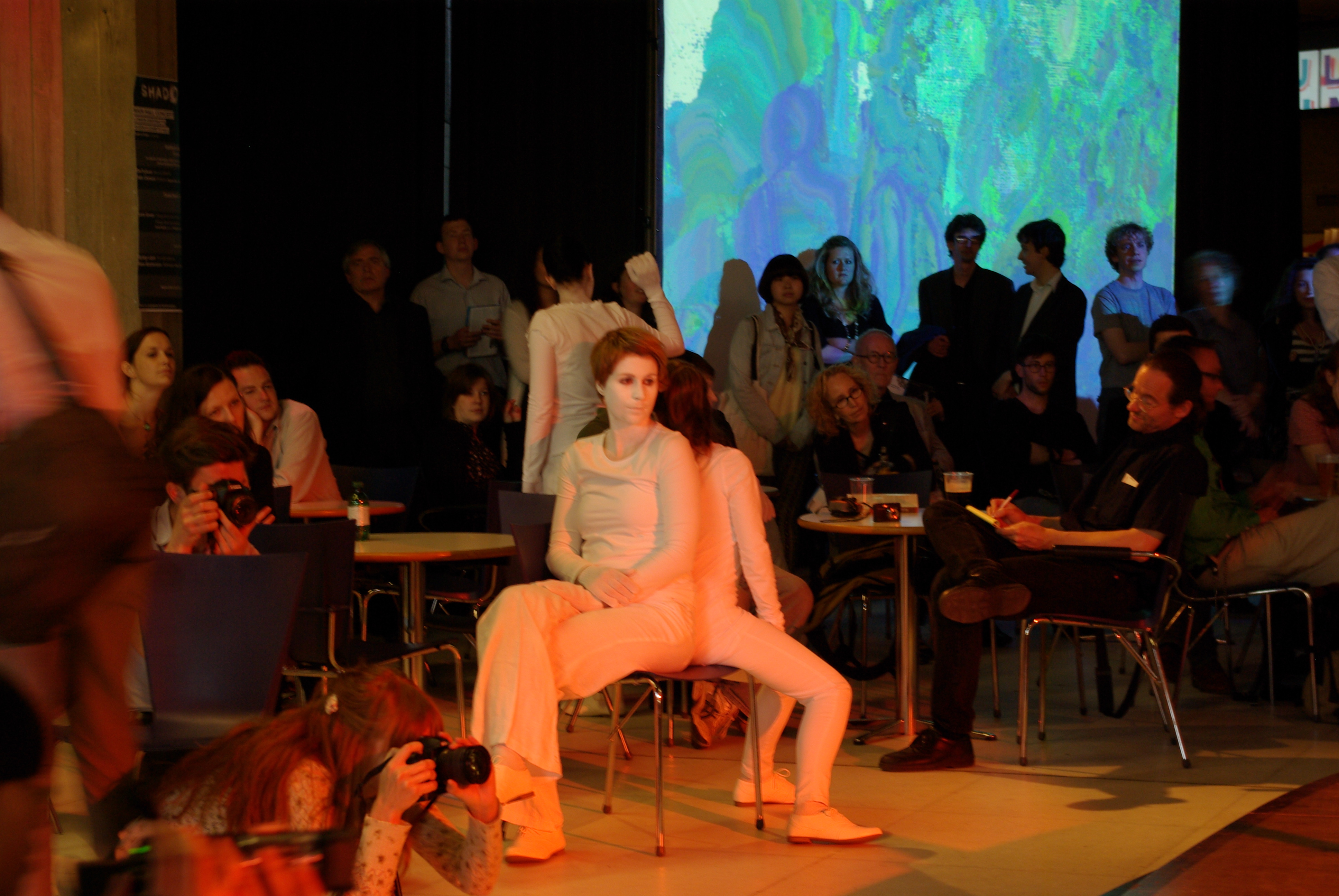
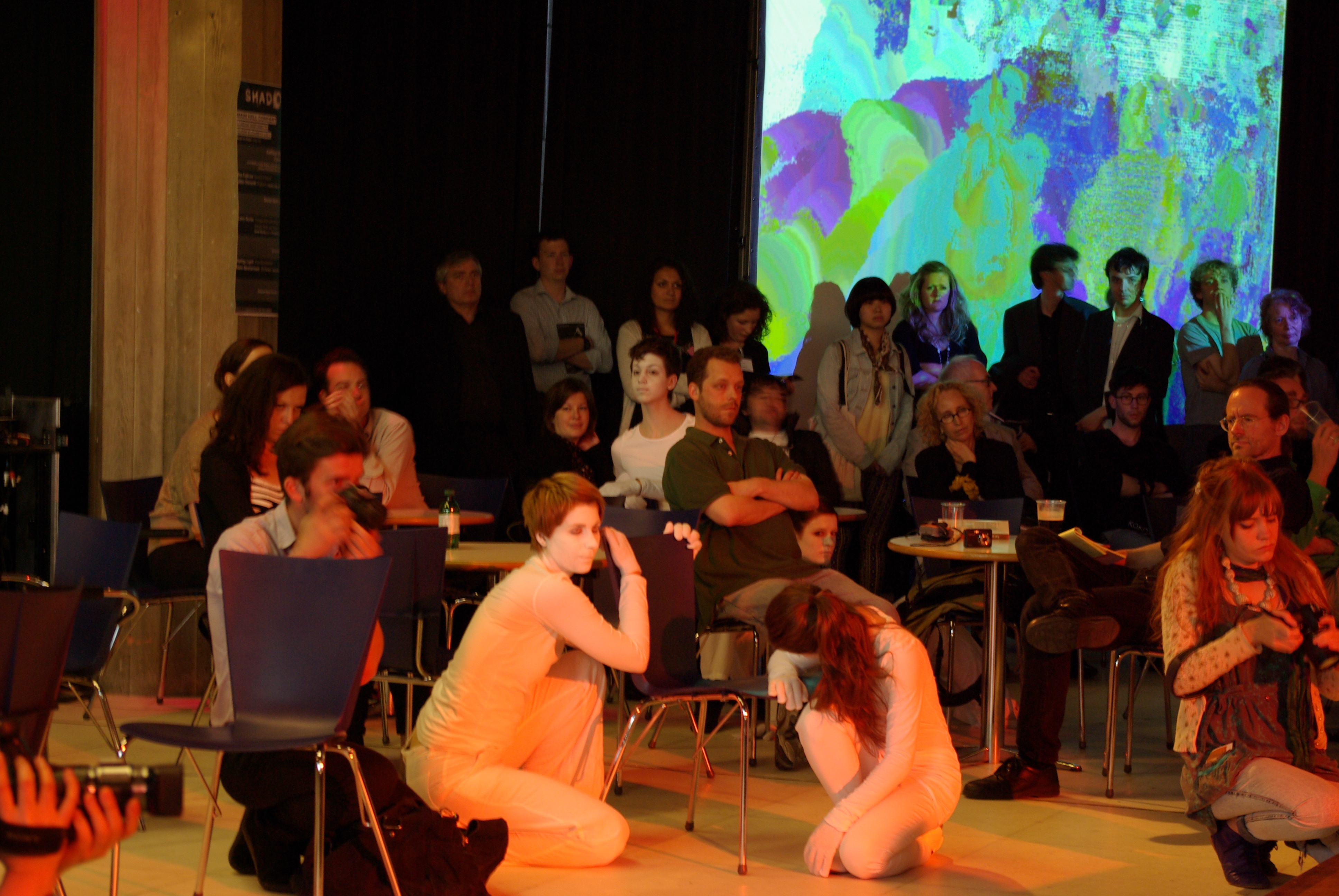
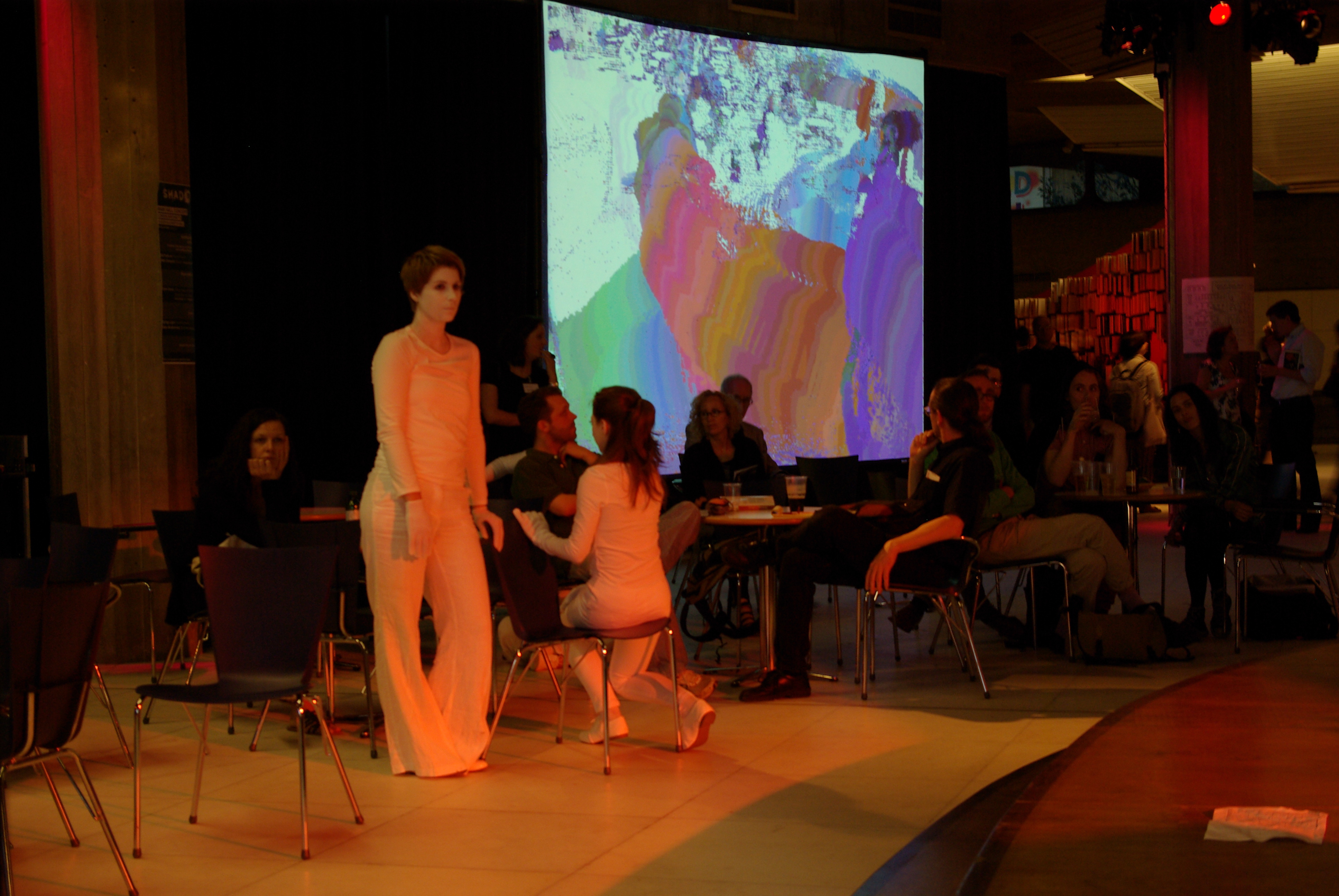
2010 Schedule Canvas Thursday & Saturday-Sunday, May 6 & 8-9, 2010 Locally Grown Dance Festival Schwartz Center lobby, Cornell University, Ithaca, New York Installation design: Allen Fogelsanger Video: above. Canvas Thursday, June 3, 2010 Shadoworks, a London Sinfonietta event curated by the London Sinfonietta Collective Queen Elizabeth Hall foyer, Southbank Centre, London, United Kingdom Installation design: Kathleya Afanador Photos: see our page about the concurrent performance of Just Hanging Around; photos which show Canvas include this, this and this. Canvas + Triggers Tuesday-Thursday, June 15-17, 2010 Abundance Dance and Choreography Festival Värmlands Museum, Karlstad, Sweden Installation Design: Kathleya Afanador and Allen Fogelsanger Videos: see our page on Canvas + Triggers at Abundance 2010. |
|
Canvas is a movement-interactive video installation run off a laptop computer. We call the underlying computer program Painterbecause it creates video frames similar to abstract expressionist paintings. First used publicly at the February 2009 Phoenix Experimental Arts Festival in our piece Red Bites for a Rainy Day, Painteris a Max 5 software program that uses a video camera to target either (a) a previously set color or (b) any movement. In each frame of video the target pixels are painteda new color, which changes gradually from frame to frame in a random walk through the video color cube, and the paintaccumulates on the screen. A separate parameter controls how quickly the paintfades (to either black or white); if the target color is not present, or if there is no movement, the canvas will gradually go blank. In performance, the target (either color or movement), the range of color used for painting, and the duration of fade time change on cues. In installation, Paintertargets movement only, while color range and fade time reset periodically, thus varying and refreshing Canvas's response to motion. Canvas, being visual, remains connected to its observers even in environments rich with sound--for instance in echoey lobbies filled with noisy theatre goers. If the installation space is quieter we can set up Canvas + Triggers, which combines Painterwith a few of our audio-producing programs that we've used in dances.
The earliest of these programs comes from the dances Playing with Liquid Mercury and Playing with Liquid Mercury II, and we may as well call it Double Keyboardbecause it essentially turns each half of the stage into a monophonic MIDI keyboard. Double Keyboardsplits video input from a camera into fifty vertical strips which are associated with pitches; the left twenty-five increase in pitch from left to right like a piano, but the right twenty-five decrease in pitch from left to right. Double Keyboardfinds the strip on each half of every video frame that shows the most change from the previous video frame, and playsthe notes associated with those strips at a volume proportional to how much change has occurred--i.e. the two halves of the stage are independent musical instruments that play louder when there's more movement and softer when there's less. Like Painter, Double Keyboardis a purely reactive program: when the computer senses movement it immediately and directly reacts, so that the dancer(s) can potentially control the computer output in at least some of its particulars--though not all. In performance Double Keyboardvaries the type of sound it produces (piano, percussion, strings) when cued by the computer operator; in installation it produces swishesonly, as heard in the video to the right. The swishysounds work with movement improvisation better than musical pitches do, probably because the "swishes" merge together more than discrete musical notes do, and so feel more like the continuous motion of a moving body. Canvas + Triggers includes two more programs, from the dance Broken Chase, which have a less direct relationship with the movement they track. Both divide the video frame into fifty vertical strips like Double Keyboard,but the strips are not used to generate pitches. The simpler of the two programs is Footstepswhich outputs ... guess what! Footstepsis anti-reactivein the sense that it does the opposite of what Painterand Double Keyboarddo; when it senses movement, Footstepsdoes nothing, but when it senses stillness, Footstepsproduces the sound of footsteps. The speed and pitch of the steps is directly related to how much movement the program Footstepsdetects just before the stillness begins. The sound of the footsteps pans back and forth across the stereo audio space, the speed of the panning determined by how quickly the filmed movement source traveled across the fifty vertical strips of video before stopping and triggering the sound. While Painter, Double Keyboard,and Footstepsessentially do nothing in the absence of motion (or color if Painteris targeting color), the last program has a certain life of its own. Agentis a program that plays a somewhat wistful sounding constantly evolving melody; when linked to a piano sound it comes off a bit as an intensely contemplative jazz pianist. In Canvas (as in Broken Chase), Agentresponds to movement and stillness, but while Footstepssimply reacts to these triggers Agentacts in ways that cannot be controlled by the dancer(s). The model of interactivity used in designing the Agentprogram's responses is that of human conversation. Agentdetects when the dancer is speaking(moving) and when the dancer is silent(not moving). As seen in the excerpt from Broken Chase to the right (in which Agentis playing over a set percussion track), generally Agentwill reply immediately upon noticing the dancer is silent, but sometimes it will wait a few seconds, thinkingabout what it is going to say.If the dancer chooses to interrupt Agentby beginning to move before it finishes playing, Agentwill probably allow the interruption and stop playing; however, occasionally Agentwill doggedly continue on regardless of the dancer's beginning to move. Likewise, the Agentmay chooseto interruptthe dancer's talking,but usually it will respectfully listento all the dancer has to saybefore replying. Thus the dancer must always be ready to respondto the Agentprogram's behavior in ways that are not necessary with the other programs operating in Canvas + Triggers. Agentis not controllable, so the relationship between dancer and Agentis interactive and not simply reactive. In Canvas + Triggers the video program Painteris always active, while the audio programs Double Keyboard, Footsteps,and Agentregularly loop through a sequence in which sometimes only one accompanies the video while at other times a combination of two or three may do so. Thus the audiovisual environment transforms from one in which audio and video (and movement) occur together to another where they do not. Each amalgamation has its own character and inspires distinct movement strategies in its human interlocutors, whose immersive experience is repeatedly renewed by the cycle of variations. |
|